
1932: Omega became Official Timekeeper of the Olympic Games. Arriving with one watchmaker and 30 split-second chronographs, it was the first time in history that one company was trusted to time every event.
1950: Longines timed the first Alpine Skiing World Championships in Aspen.
1972: Swiss Timing was founded in Biel, Switzerland. Signatories included the Federation of the Swiss Watch Industry (FH), Omega, and Longines.
1973: Swiss Timing measured the World Canoeing/Kayaking Championships for the first time. In the same year, OMEGA Electronics was created.
1976: Swiss Timing measured the summer and winter editions of the Olympic Games in Montreal and Innsbruck. The partner brands were Omega, Longines, and Heuer.
1980: Longines became the Official Timekeeper of the Formula One Grand Prix.
1983: The merger of ASUAG and SSIH resulted in the Société de Microélectronique et d’Horlogerie SA (SMH), the holding company that would later be renamed Swatch Group. The future of Swiss Timing was included as part of that commitment.
1988: OMEGA Sports Timing workshops were relocated to St. Imier, combining the timekeeping teams under the same roof for the first time. The Longines R&D, industrial, and marketing departments were integrated into OMEGA Electronics.
1989: Swiss Timing partnered with the Tour de France and World Cycling Championships on behalf of Tissot.
1990: Swiss Timing partnered with Breitling to time the First World Equestrian Games in Stockholm.
2001: OMEGA and Swiss Timing’s role as Official Timekeeper of the Olympic Games was extended through to the Olympic Winter Games Vancouver 2010.
2005: Swatch Group integrated the sport department at OMEGA Electronics into the Swiss Timing structure, and the following year, Swiss Timing acquired Wige Data and Wige Innovation in Germany and Wige MIC in the Czech Republic. The acquisitions gave the company the profile it enjoys today.
2006: Swiss Timing relocated to its current location in Corgémont, Switzerland.
2009: Swiss Timing’s contract with the IOC was extended to include each edition of the Olympic Games through to Tokyo 2020.
2012: At London 2012, Omega marked 80 years of Olympic Games timekeeping. From 30 split-second chronographs in 1932, the brand was now relying on 450 tonnes of state-of-the-art equipment.
2017: Swiss Timing’s contract with the IOC was extended to include each edition of the Olympic Games through to Brisbane 2032.
2018: At the PyeongChang 2018 Winter Olympics, Swiss Timing deployed wearable sensors at scale, enabling advanced performance analysis through real-time position, motion, and speed tracking.
2020: Swiss Timing introduced distributed timekeeping, reducing on-site infrastructure while establishing cloud-native data pipelines for remote event operations.
2022: Swiss Timing expanded the use of computer vision integrated with AI/ML across multiple sports, enabling a shift from raw data capture to contextual performance analytics and automated insight generation.
2024: Swiss Timing advanced toward fully integrated real-time sports data platforms, aggregating multi-source data to deliver unified insights and enable richer storytelling for sports organizations and broadcasters.
Historic innovations
2026: The fusion of multiple data sources unlocks entirely new insights by enabling real-time performance analysis in the context of historical benchmarks. By integrating all data streams into a unified data hub - enhanced with advanced analytics and visualization tools - sports organizations and broadcasters are empowered to transform complex data into compelling storytelling and deeper performance understanding.
Advanced broadcast graphics were introduced to enable augmented reality comparisons of alpine skiing trajectories, allowing viewers to directly visualize and contrast athletes’ lines in real time during competition.
2024: At the Paris 2024 Summer Olympics, unprecedented depth of analysis in the 4x100m hurdles relay were delivered: Every jump of each athlete was captured and evaluated in real time, revealing exactly where races were won and lost and unlocking a new level of performance insight.
2022: Artificial Intelligence systems were introduced to enable continuous, real-time observation of athlete performance directly on the field of play. In Figure Skating, this marked a breakthrough moment: for the first time, the technical execution of skaters became objectively measurable—laying the foundation for data-driven judging support and the next generation of performance evaluation.
2020: In response to the COVID-19 pandemic, distributed timekeeping was introduced, reducing on-site infrastructure while establishing cloud-native data pipelines for remote event operations.
2018: At PyeongChang 2018, OMEGA began paving the way for a dynamic Olympic Games future. Through incredible sensor systems, the brand provided continuous measurements from start to finish of events, such as live speed, position, and jump analysis. This meant that athletes could gain an immediate understanding of where they gained or lost time, or where they won or lost points.
2017: At the FIS Alpine World Ski Championships in St. Moritz, the game-changing Longines Live Alpine Data system was introduced. Consisting of a chip attached to the skier’s boot, equipped with a radar and motion sensor, the system enables the real-time and continuous measurement of an athlete’s speed, acceleration and deceleration, the time it takes to reach 100km/h, and an analysis of jumps.
2016: At Rio 2016, False Start Detection in Athletics was enhanced with built-in sensors that measured force against the footrest, 4,000 times per second.
The Scan’O’Vision MYRIA was introduced, able to take up to 10,000 images per second on the finish line of races.
A new Archery target system was introduced. When the arrow hit the target, two scanners calculated its position within 0.2mm accuracy, a task impossible for the human eye.
The NBA and Tissot partnered on a new integrated timing system and shot clock. The clock appeared to be cable-free and was equipped with LED glass, making it almost completely transparent. It integrated the 24-second, timeout, and game clocks in one unit.
2014: At the Olympic Winter Games Sochi 2014, new technologies included the Quantum Timer in Alpine Skiing, a localized GPS system, speed measurement in Cross Country, and some virtual 2D measurements, making it possible to see the height or length of jumps in Ski Jump, Half Pipe, and Freestyle Skiing.
2013: The Atomic Quantum Timer became the first device driven by an integrated atomic clock, improving accuracy by a factor of 100 (<0.03 sec/year).
New Swiss Timing technology detected a referee’s whistle in ice hockey – even during the noisiest of games. When the whistle was blown, the clock stopped immediately.
2011: New starting blocks for athletics events included force sensors that continually measure an athlete’s thrust force, improving false start detection.
2010: The Electronic Starting Pistol was introduced at the Olympic Winter Games Vancouver 2010. A streamlined, futuristic device connected to a sound generation box.
These Games also saw the debut of a high-definition judges’ scoring system for figure skating, the ultra-precise Chronos Timer, and the Snowgate Starting Gate used in alpine skiing.
The Quantum Timer was introduced. Representing a completely new generation of timekeeping devices, it was connected directly to computers and offered a resolution to a millionth of a second.
In summer sports, a new touchscreen keyboard for gymnastics judges offered easier, more consistent scoring.
2008: Automatic point calculation in real time was introduced in Taekwondo.
Athletes were given integrated bib transponders in distance running events, a development that made it easy to keep track of their positions throughout the race.
A new swimming start block was introduced, which introduced a footrest departure assistance feature.
The Commentator Information System (CIS) was now available worldwide through the Internet on standard computers.
The new Scan’O’Vision Star was able to record 2,000 frames per second.
GPS was used for the first time in rowing, canoeing, and kayaking as well as in sailing and road cycling events.
2007: Swimming was now timed at 100 frames per second, thanks to high-speed video (HSV). At Beijing 2008, this technology confirmed Michael Phelps’ hundredth of a second victory margin over Milorad Cavic in the 100m butterfly final.
2005: New breakthroughs in gymnastics included the Instant Replay and Communications System (IRCOS) and the Video Assist Judging System. All presented at the World Championships in Melbourne.
2004: The new Chronos timer brought an unparalleled level of accuracy to sports timekeeping.
Virtual graphics in swimming (the virtual record line) and ski jumping (distance) were immediate hits with fans and viewers.
2001: The Commentator Information System (CIS) was made available on a standard computer network.
2000: Live Timing distributed the results and photofinish images in swimming events via the Internet. Fans could see the results in real time at omegatiming.com.
The real-time display of boxing punches was introduced.
The Saturn Console for team sports was debuted.
1999: Transponders were introduced in cross-country skiing to keep track of athlete positions.
1997: Drivers’ voices were heard for the first time in CART (formerly Indy Car).
1996: Wind measurement technology was integrated into the scoring of ski jumping.
GPS technology was used for the first time in sailing to track competitors.
The very first super VHS colour video cameras with CCD sensors were used in the timing of swimming events.
1995: Scan’O’Vision images were created in colour for the first time.
ARES – the Advanced Results Entry Station – fused chronometry and information technology. The digital era of sports timekeeping had arrived.
Swiss Timing launched the Micro Smart Terminal (MST), a timing and multi-sport display.
The first fully automatic starting system was introduced in track cycling, specifically for pursuit events as well as the 500-metre, one-kilometre, and team sprints.
1993: The Hawk Eye photofinish camera introduced high-resolution scanning technology embedded in a computer.
1991: Active new transponders were introduced in motor sport, capable of timing 128 cars at the same time.
1990: The Scan’O’Vision photofinish camera was introduced and used to measure the distance of ski jumps.
1976: The OMEGA video matrix scoreboard was debuted at the Olympic Games Montreal 1976. In the same year, Swiss Timing was on hand – under that name – as Official Timekeeper of the Olympic Winter Games.
1968: Omega introduced swimming touch pads. Featured for the first time at the Olympic Games Mexico 1968, the technology at both ends of the swimming pool caused a sensation, allowing competitors to stop their own clocks.
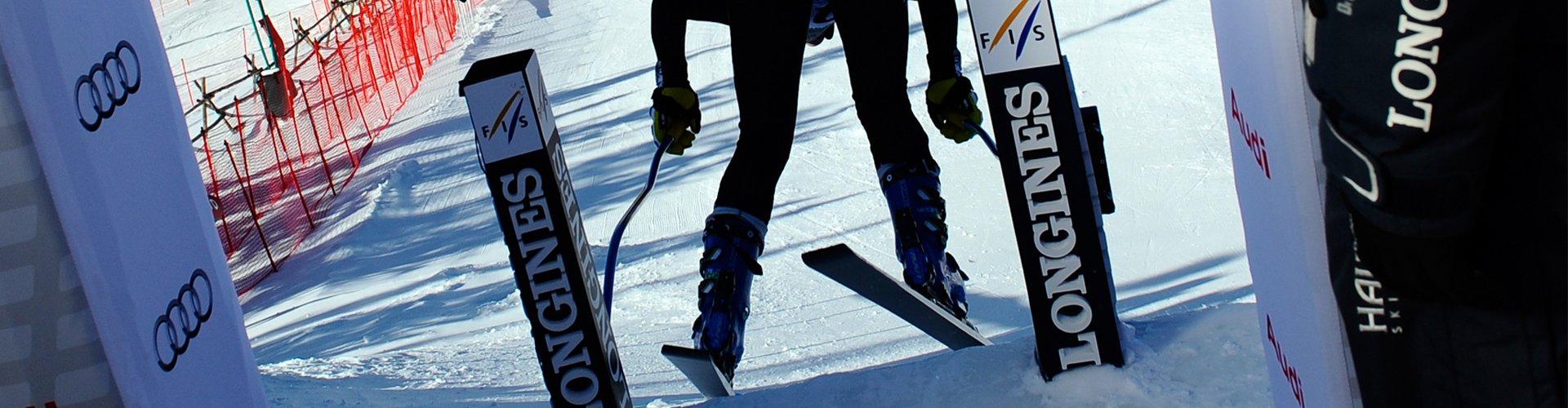
1950: New electro-magnetic gates arrived in skiing. Longines introduced the technology at the Alpine Skiing World Championships in Aspen, Colorado, accurately recording each competitor’s start and finish times.
1948: The electronic era began at the Olympic Games London 1948, where Omega introduced its photoelectric cells, which automatically stopped the clock at the exact moment a runner crossed the finishing line.
The first photofinish camera, the Racend OMEGA Timer, also arrived, changing timekeeping forever.
